Water
Household water reserve, utility water, water supply. If the water is for drinking, state it when ordering, it affects material choice.
1000 · 2000 · 3000 · 5000 litres
From 250 to 50,000 litres, HDPE and PP, built to order. See the exact dimensions before you order.
Price from 70,000 RSD
2 variants
Fits through a 3 m gate
By liquid
The tank is chosen for the liquid, not the other way round. A water tank and a fuel tank do not share the same technical requirements, so state the use in your first enquiry.
Household water reserve, utility water, water supply. If the water is for drinking, state it when ordering, it affects material choice.
1000 · 2000 · 3000 · 5000 litres
Collecting roof runoff for watering gardens, orchards and vineyards. Connects to gutters, a filter and an overflow.
2000 · 3000 · 5000 · 10000 litres
Heating oil, diesel and other fuels. Requires a purpose-built tank, correct sizing and compliance with flammable liquid regulations.
1000 · 3000 · 5000 · 10000 litres
Fermenting and storing wine, must and brandy. Can be built with taps, valves, level indicators and a floating lid.
500 · 1000 · 2000 · 5000 litres
A permanent water reserve for fire protection. Volume is set by the building's fire protection design.
10000 · 20000 · 30000 · 50000 litres
Water reserve for crops. Volume depends on area, watering method, water source and refill frequency.
3000 · 5000 · 10000 · 20000 litres
Technical data
Vertical cylindrical tanks. Where a volume has several variants you choose between a lower and wider or a narrower and taller model, based on your space and access.
| Volume | Diameter (D) | Height (H) | Variants | Price from |
|---|---|---|---|---|
| 250 L | 600 | 800 | 1 | on request |
| 500 L | 800 | 1000 | 1 | on request |
| 1,000 L | 1000 | 1300 | 1 | on request |
| 1,500 L | 1200 | 1350 | 1 | on request |
| 2,000 L | 1300 | 1500 | 1 | on request |
| 2,500 L | 1300 | 1875 | 1 | on request |
| 3,000 L | 1600 | 1500 | 1 | on request |
| 4,000 L | 1600 | 2000 | 1 | 60,000 RSD |
| 5,000 L | 1600 / 1800 | 2500 / 1960 | 2 | 70,000 RSD |
| 6,000 L | 1600 / 1800 / 2000 | 3000 / 2400 / 1950 | 3 | on request |
| 7,000 L | 1800 / 2000 | 2800 / 2260 | 2 | on request |
| 8,000 L | 2000 / 2400 | 2570 / 1790 | 2 | on request |
| 9,000 L | 2000 / 2400 | 2900 / 2020 | 2 | on request |
| 10,000 L | 2000 / 2400 | 3200 / 2240 | 2 | on request |
| 12,000 L | 2400 | 2680 | 1 | on request |
| 15,000 L | 2400 / 3000 | 3360 / 2150 | 2 | on request |
| 20,000 L | 2400 / 3000 | 4470 / 2850 | 2 | on request |
| 22,500 L | 2400 / 3000 | 4990 / 3200 | 2 | on request |
| 25,000 L | 2400 / 3000 | 5560 / 3550 | 2 | 270,500 RSD |
| 30,000 L | 2400 / 3000 | 6720 / 4260 | 2 | on request |
| 35,000 L | 3000 | 4970 | 1 | on request |
| 40,000 L | 3000 | 5700 | 1 | on request |
| 45,000 L | 3000 | 6390 | 1 | on request |
| 50,000 L | 3000 | 7100 | 1 | on request |
Price depends on the use, fittings and extra equipment. Transport is charged separately based on the delivery address.
Choosing
The first question is not which is better, but which you have less of: floor area in the yard, or height above the installation point.
The decision comes down to two numbers you can measure yourself, before you call us. The first is the free ground area where the tank will stand. The second is the clear height above that spot, measured to the first obstacle: the eaves, a branch or the ceiling of an outbuilding, not the sky. A vertical tank is filled from the top, so allow for room above the inspection hatch as well.
There is a third number that is most often overlooked and only shows up on delivery day: the width of the approach. The tank is made and delivered in one piece and does not come apart, so it has to pass through the gate and along the house. What matters there is the diameter, not the volume.
That is why a lower tank is not always the easier one to deliver, often the opposite. Between 15,000 and 30,000 litres the lower variant is 3000 mm in diameter and will not pass a three metre gate, while the taller 2400 mm variant will. From 35,000 litres up we only make the 3000 mm diameter, so the approach is agreed in advance or a crane is budgeted for. The tool at the top of this page checks the clearance for each variant separately.
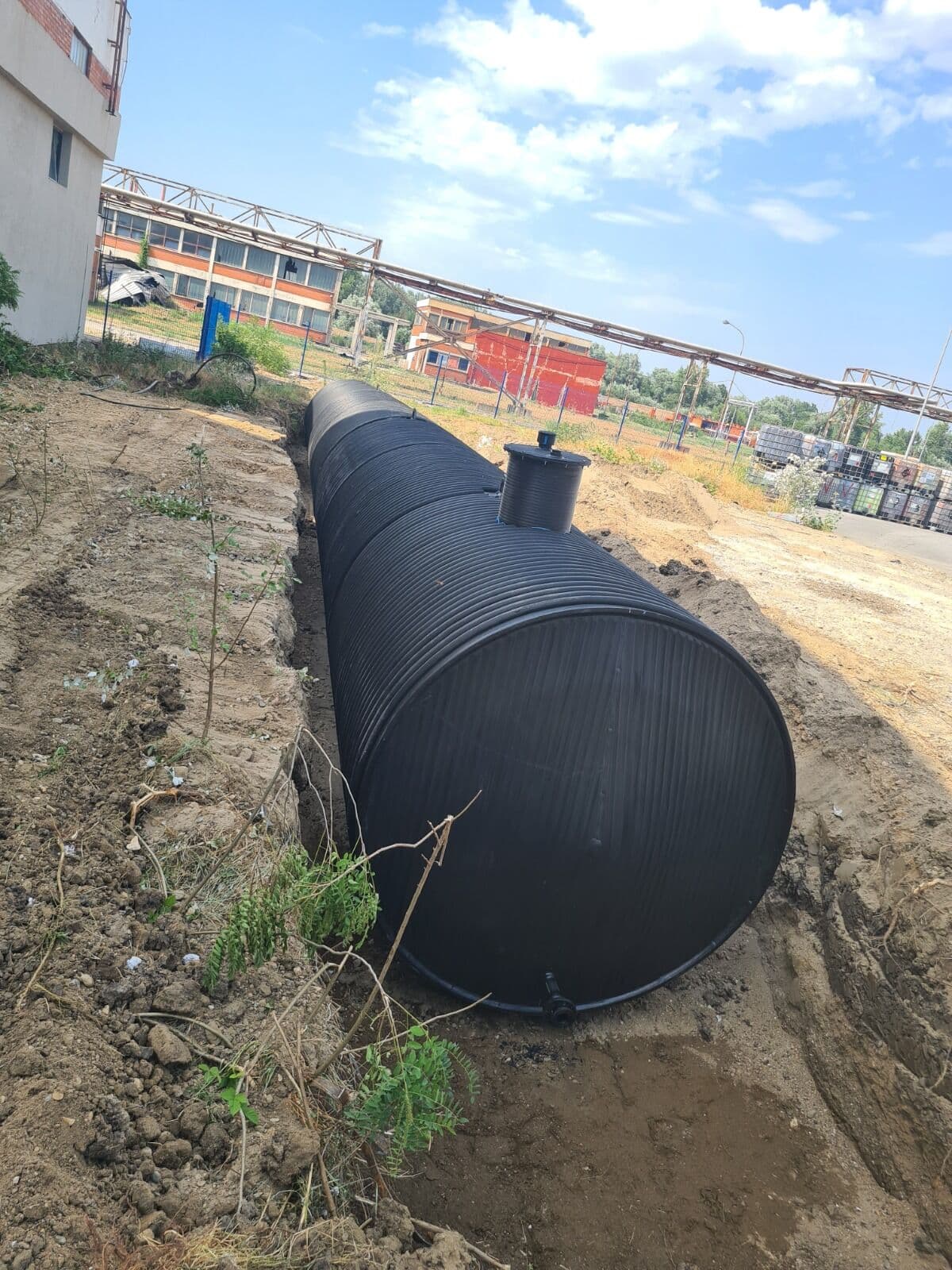
If you are planning to bury the tank, the choice is already made. Buried tanks are horizontal, a vertical tank stays above ground.
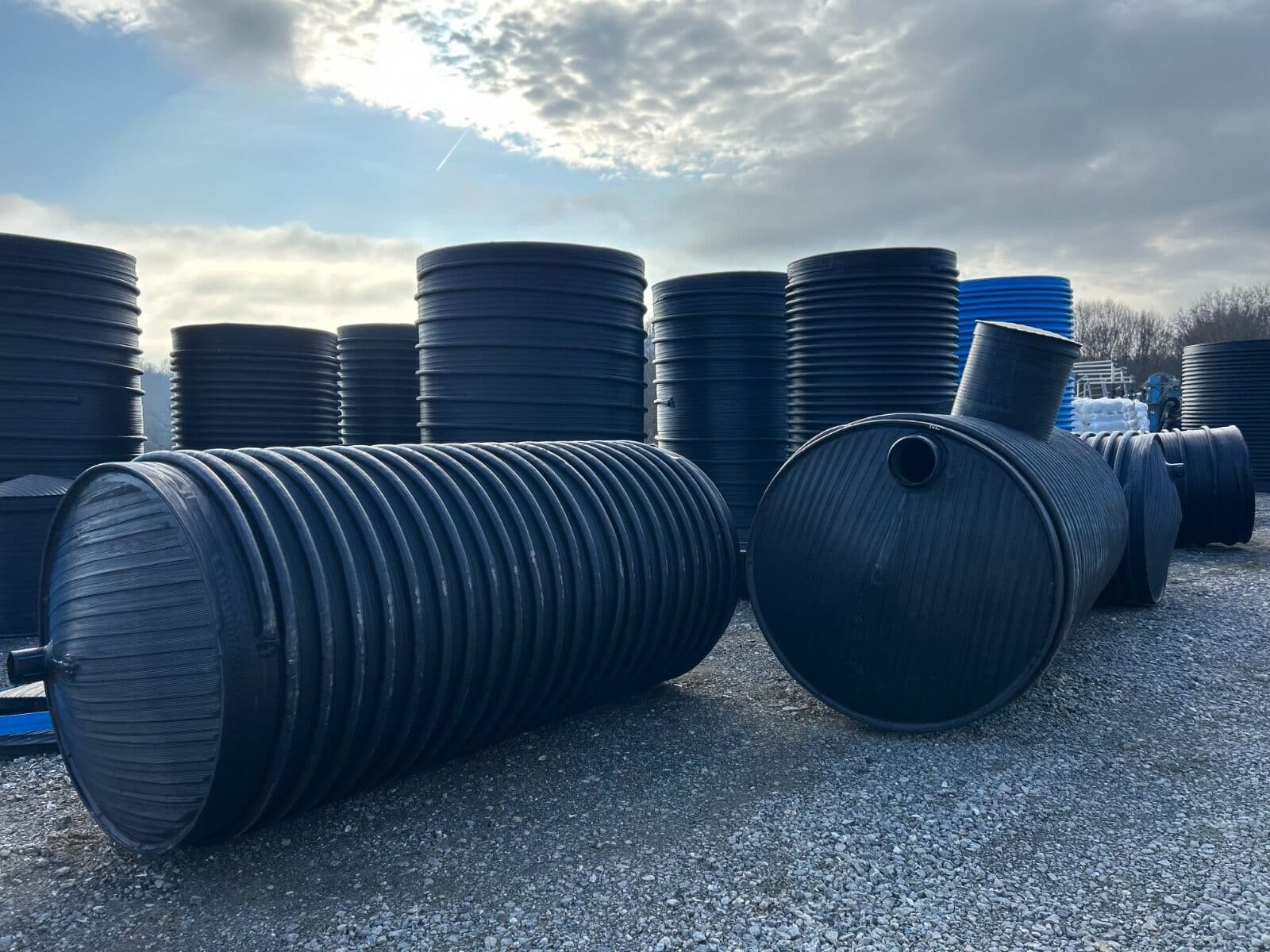
A vertical tank takes up a smaller footprint, so it suits narrow plots and crowded yards. It needs more height, and filling and emptying is simpler because the contents settle towards the bottom.
A horizontal tank is lower, so it fits under a canopy, into an outbuilding or a greenhouse. It takes up more area, but it is also the first choice when burial is planned.
Before ruling out a vertical tank on height, check the table: for 11 of the 24 volumes we offer more than one diameter. The 8,000 litre tank comes as Ø2000 at 2570 mm and as Ø2400 at 1790 mm, so 78 cm lower for the same volume. At 30,000 litres that difference is 2.46 metres.
| What we compare | Vertical | Horizontal |
|---|---|---|
| Footprint in the yard | Smaller, fits a narrow plot and a crowded yard. | Larger, needs more free ground. |
| Height needed | More, so check what sits above the installation point. | Less, fits under a canopy, into an outbuilding or a greenhouse. |
| Burying | Not buried, it stays above ground. | Every buried tank is horizontal, that is its first job. |
| Filling and emptying | Contents settle towards the bottom, which is simpler. | Contents spread along the length of the tank. |
| Choice of height for one volume | For 11 volumes there is a lower variant too, in the table below. | The height is the diameter of the tank, there is no second choice. |
The “lower by” column shows how much lower the lowest variant is than the tallest one, for the same number of litres.
| Volume | Tallest variant | Lowest variant | Lower by |
|---|---|---|---|
| 5,000 L | Ø1600 × 2500 | Ø1800 × 1960 | 540 mm |
| 6,000 L | Ø1600 × 3000 | Ø2000 × 1950 | 1050 mm |
| 7,000 L | Ø1800 × 2800 | Ø2000 × 2260 | 540 mm |
| 8,000 L | Ø2000 × 2570 | Ø2400 × 1790 | 780 mm |
| 9,000 L | Ø2000 × 2900 | Ø2400 × 2020 | 880 mm |
| 10,000 L | Ø2000 × 3200 | Ø2400 × 2240 | 960 mm |
| 15,000 L | Ø2400 × 3360 | Ø3000 × 2150 | 1210 mm |
| 20,000 L | Ø2400 × 4470 | Ø3000 × 2850 | 1620 mm |
| 22,500 L | Ø2400 × 4990 | Ø3000 × 3200 | 1790 mm |
| 25,000 L | Ø2400 × 5560 | Ø3000 × 3550 | 2010 mm |
| 30,000 L | Ø2400 × 6720 | Ø3000 × 4260 | 2460 mm |
Price
There is no single price per litre, because every tank is built to order. These are the four things that move it, in order of how much they matter.
The largest item, but it does not rise in a straight line. The price per litre falls as the tank grows: at 4,000 litres it works out at about 15 dinars per litre, at 25,000 about 11. That is why two smaller tanks almost always cost more than one larger tank of the same total volume.
Inlet and outlet, taps, valves, an inspection hatch and a level indicator are chosen as needed. Aggressive contents call for reinforcement, a double wall, a containment basin and ventilation, with fittings selected for the job, and that item can be substantial.
A tank for burial has a different structure and a thicker wall because it takes soil pressure, so it costs more than an above-ground tank of the same volume. Site work comes on top: excavation, bedding and backfill, and a concrete slab with anchoring where groundwater is high.
Charged separately, based on the delivery address. Large tanks are unloaded from a truck, so access matters, as does whether a crane is needed. That is why we always ask about the width of the access road and gate before quoting a final figure.
Prices in the table are starting prices, for an above-ground tank without extra equipment and without transport. For an exact figure send us the volume, the use and the delivery location.
Tool
A rough estimate based on intended use. Call us for an exact choice.
Basis of the estimate: A roof of 80 m² collects about 48,000 litres a year. Divided across twelve months, that is roughly 4,000 litres per month.
Recommended volume
4,000 L
Closest model we make
Ø1600 mm × 2000 mm
Estimates for household use and irrigation are being prepared. Until then, please call us, it is quicker to go through your case together.
Step by step
Burying is planned in advance. A tank built purely for above-ground use should not be buried later, because its structure is not designed for soil pressure.
The pit is dug with enough clearance on every side for backfill. The base must be level and free of stones that would load the wall at a single point.
A layer of sand is laid and compacted, or a concrete base is poured. The bedding spreads the load and stops the tank resting on one point.
The tank is lowered evenly, without impact. Because plastic is light, heavy machinery is usually unnecessary, but access must be checked in advance.
Backfill goes in layers, evenly on all sides, while the tank is filled with water at the same time. This equalises pressure inside and out.
Where the groundwater level is high, an empty tank can float up. A concrete slab and anchoring are then required. Tell us about the ground before we build.
Material
We work with HDPE and PP granulate. The material follows what goes into the tank and where it stands, not the other way round.
We use virgin granulate only. Recyclate is cheaper but carries an unknown composition and uneven wall thickness, and with drinking water it changes taste and smell. If the tank is meant for drinking water, tell us when ordering so we can match the material and the build.
A tank standing outdoors takes both UV and temperature swings. Ours work between minus 30 and plus 60 degrees. Frost does not damage the material itself, but it does damage water that freezes inside, so tanks used all year are buried or placed in a heated space.
With septic tanks the difference is in the joints. Concrete rings stack on top of each other and almost always leak where they meet, which is hardest to fix once the tank is in the ground. A plastic tank is moulded in one piece, with no joint for the contents to escape through.
Coverage
We have no sales points outside Osečina. Everything is built to order at the Plužac plant and delivered straight to your address.
Contact
Send us the volume, the use and the delivery location, we reply with the price of manufacture and transport.
The price depends on volume, intended use, fittings and extra equipment, and transport is charged separately based on the delivery address. Indicative prices for some volumes are in the table above. For an exact quote, send us the volume, the use and the delivery location.
A vertical tank is more practical where floor area is limited, because it takes up a smaller footprint. A horizontal one suits places where height is restricted. For several volumes we offer more than one diameter for the same capacity, so a low space can often still be solved with a vertical model, 6,000 litres, for instance, comes in three variants.
No. A tank built purely for above-ground use should not be buried later, because its structure is not designed for soil pressure. Burying is planned in advance and stated when ordering, so the structure and wall thickness can be adapted.
The HDPE and PP we use are virgin material with no recyclate, and they do not change the taste, smell or composition of water. If the tank is intended for drinking water, say so when ordering so we can select the right material and build.
We do not. Everything is built to order at the Plužac plant near Osečina and delivered straight to the agreed address. Because of that, check the width of your access road and gate when ordering, larger tanks are unloaded from a truck.
Service life depends on what is inside it and where it stands, not on the volume. A water tank that is buried or in the shade lasts considerably longer than the same tank exposed to sun all year, because UV is the main load here. That is why we use virgin granulate, with no recyclate, where composition and wall thickness are consistent.
The material handles cold, the working range is minus 30 to plus 60 degrees. The damage comes from ice, because water expands as it freezes and presses on the wall and the fittings. Tanks used all year are therefore buried below the frost line or placed in a heated space, while seasonal ones need a drain at the lowest point so they can be emptied fully before winter.
Two measurements are needed: the width of the narrowest point on the way in, and the height under anything above it, so canopies, gate arches, cables or branches. A plastic tank does not come apart, so what will not pass the narrowest point will not pass at all. If your chosen model does not fit, the same volume often exists in a smaller diameter.
For water, yes: the same tank covers the garden, livestock watering and an orchard, and one larger tank costs less per litre than two smaller ones. What must stay separate are plant protection products, because residues are not removed by ordinary rinsing, and anything in contact with food or drinking water. Fuel, slurry and chemically active contents call for purpose-built tanks.